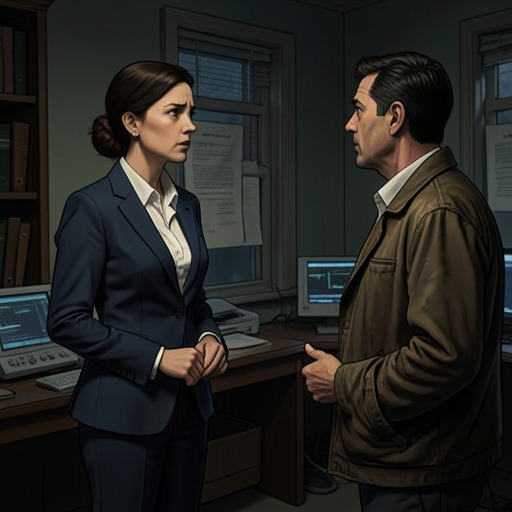
Fabiana Reassesses Ted’s Case
Crimson LakeFabiana Grisham’s reassessment of Ted Conkaffey’s case begins when she asks him to revisit the day Claire Bingley disappeared. The conversation shifts her from reporting on the accusation to actively testing its chronology: she considers whether the timing leaves room for someone else to have taken Claire, and whether that person was already nearby. Her inquiry offers Ted a possible alternative to the prosecution’s account, but it cannot restore the missing minutes or settle what he remembers.
A Question Reopened
Fabiana asks Ted to take her through the day. He is initially incredulous that she may be reconsidering the case, reminding her that she works for the newspaper and has already heard his account. Her response is not that she has reached a verdict. She says she has been looking closely at the evidence and has found parts of the case that do not make sense.
Her investigation has been shaped in part by Valerie Gratteur, who urged her to examine Ted’s arrest photographs. Valerie had pointed out that Ted appeared to have no marks and advanced a theory about defensive wounds; she also told Fabiana to investigate Trevor Fuller, a potential silent witness. Fabiana has not been able to find much about Fuller. The lead therefore remains suggestive rather than established, but it gives her a reason to question whether the case’s apparent gaps have been adequately examined.
Reconstructing the Bus-Stop Timeline
Fabiana focuses on the narrow interval between Ted leaving the bus stop and Claire’s disappearance. Sally Hope placed her mother’s passing at 12:47 p.m., a time she remembered because she checked the car clock and worked out how long remained before her dance lesson. A red Kia carrying Jessica and Diana Harper passed at 12:49; their testimony placed Ted talking with Claire. The witnesses also differed over whether Ted’s rear passenger door was open, and later accounts disagreed over whether his gesture to Claire looked like a goodbye or an invitation to come closer. The witnesses agreed only that he gestured while standing beside the door nearest the girl.
Ted left at 12:50. Claire was gone when her bus passed two minutes later. Fabiana asks what follows if those times are not exact. She proposes that the clocks in the cars and on the bus might all have been slightly wrong, stretching the interval from two minutes to four. This is a hypothetical adjustment, not a corrected timeline, but it changes the question: instead of treating the recorded minutes as a fixed window, she asks what actions that window could actually contain.
Even with the longer estimate, Fabiana reasons, an abductor would have had little time to get out of a car, reach Claire, take her, and drive away. That constraint, she argues, points to someone very close to the bus stop when Ted left. The person might have been watching already and paused when Ted unexpectedly arrived, then moved once he drove off. Fabiana does not identify that person or prove that this is what happened. She shows how the same compressed timeline used against Ted can also be read as evidence that another person was nearby.
The Limits of What Was Seen and Remembered
The testimony surrounding the stop is precise in some particulars and uncertain in others. Sally’s time has a remembered explanation—the journey to a dance lesson—while the other witnesses’ descriptions leave basic details unresolved. The argument over Ted’s hand gesture lasted three days in court, yet its eventual common ground is simply that he made some kind of gesture. Such variation does not by itself prove that the witnesses were mistaken; it does show how much meaning the case placed on brief observations made by passing motorists.
The case also rests on Claire’s identification and on accounts of what she said after the abduction. Ted had already been told by Kelly that Claire chose his photograph from a lineup. In court, the jury watched recordings made not long after Claire left hospital: she was badly bruised, her eyes moved restlessly, and she experienced night terrors and difficulty eating. She barely looked at the photographs and spoke in fragments, sometimes whispering or rambling. The prosecutor described her eye movements as a post-traumatic stress symptom.
One phrase from the interviews received particular attention because it connected the abductor with a policeman. But the recordings also show Claire repeating the counsellor’s question about whether she had said the man was a policeman; the prosecution replayed that clip repeatedly. The sequence makes the distinction between a child’s initial words and language echoed from an interviewer consequential. It does not establish that Claire’s identification was false, but it complicates any effortless reading of the recording as a clear, independent account.
An Unfinished Inquiry
When Fabiana asks whether Ted noticed other cars or heard anything in the moments before he left, he cannot supply a new observation. His body registers the pressure of the questioning—sweat spreads across his back—as the possible alternative grows harder to consider. Looking toward the mountains, he stands and takes the bottle from the porch, ending the conversation. He says that all he remembers is the girl.
That answer leaves Fabiana’s reconstruction open. Her reasoning gives the case a plausible line of inquiry: a person nearby may have watched Ted arrive, waited until he departed, and abducted Claire within the brief interval before her bus came. Yet the proposed explanation depends on uncertain clocks and an unseen person, while Ted’s own recollection cannot fill the gap. The reassessment therefore alters the shape of the accusation without resolving it. It places the bus-stop evidence under renewed scrutiny and makes the limits of timing, observation, and traumatic testimony part of the case itself.